Shut in a garage since 1965 — an original Poole AB comes home
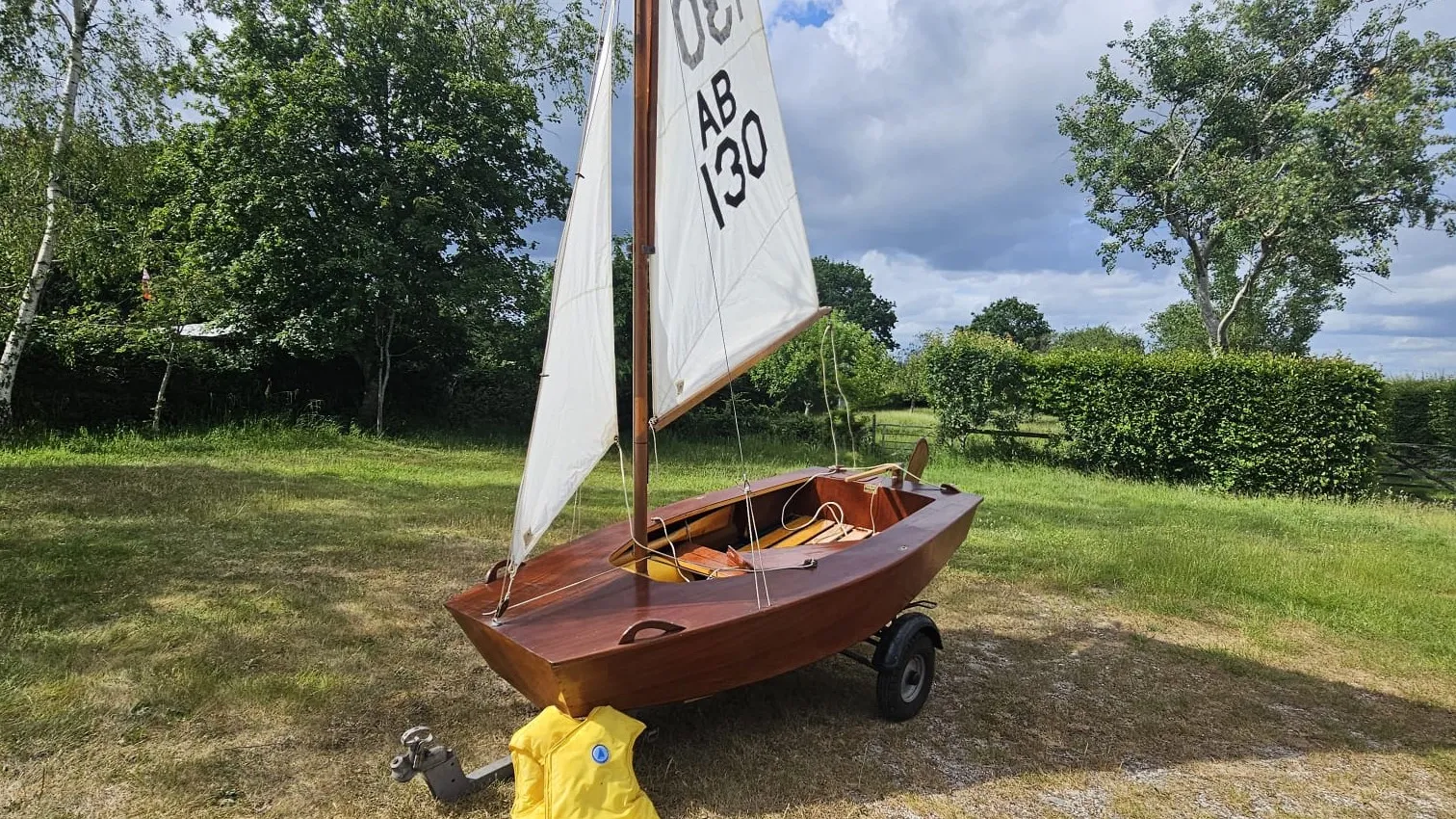
Every class has a boat it would like to find, and this one takes some beating: an original Poole AB, shut in a garage since 1965 and untouched since, has been bought and brought back out into the daylight.
She is as complete as these things get. The varnished mahogany hull, the Terylene sails, the wooden spars and the slatted floorboards are all as they were when she came off the water. So is what was stowed with her: a 1960s lifejacket still in its packet, and the Seagull outboard that would have pushed her home on a windless evening.
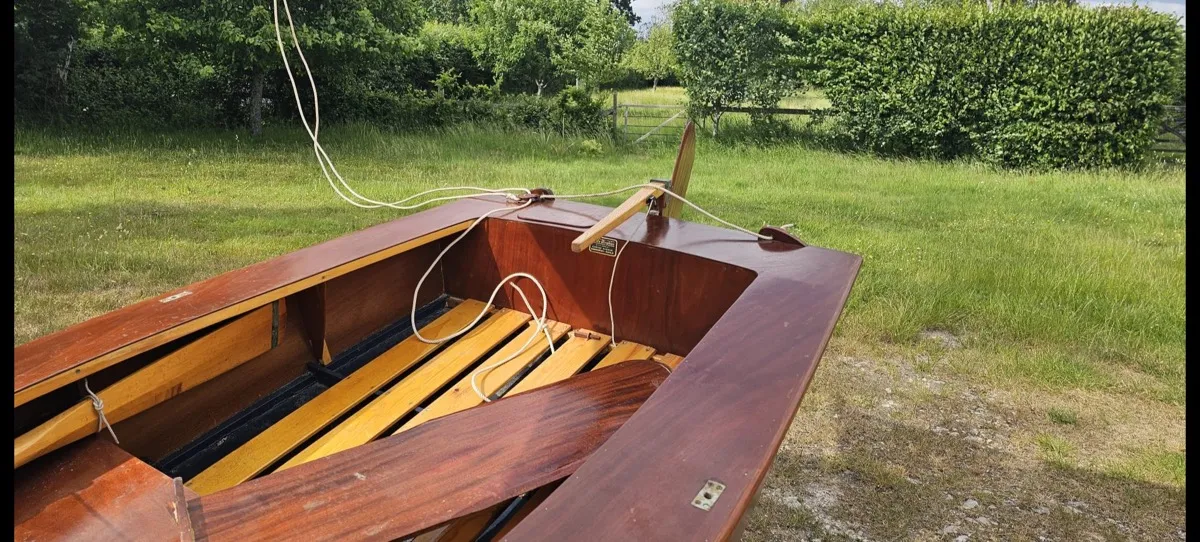 Untouched below: the original floorboards, the rudder, and the builder’s plaque still on the bulkhead.
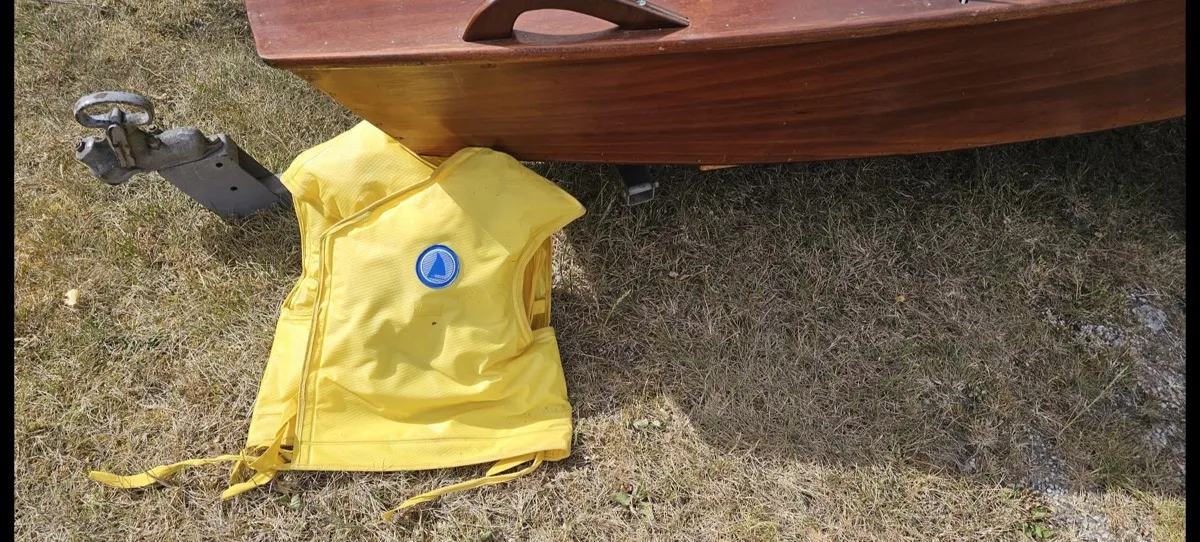 The lifejacket — found still in its original packet.
What came with her
The Seagull came with its whole folder: the twentieth edition of the operating instructions from British Seagull at Fleets Bridge, Poole, an unused service record card, and the spares leaflet — with the engine’s type and number logged in ink on the front, exactly as the leaflet nags the owner to do.
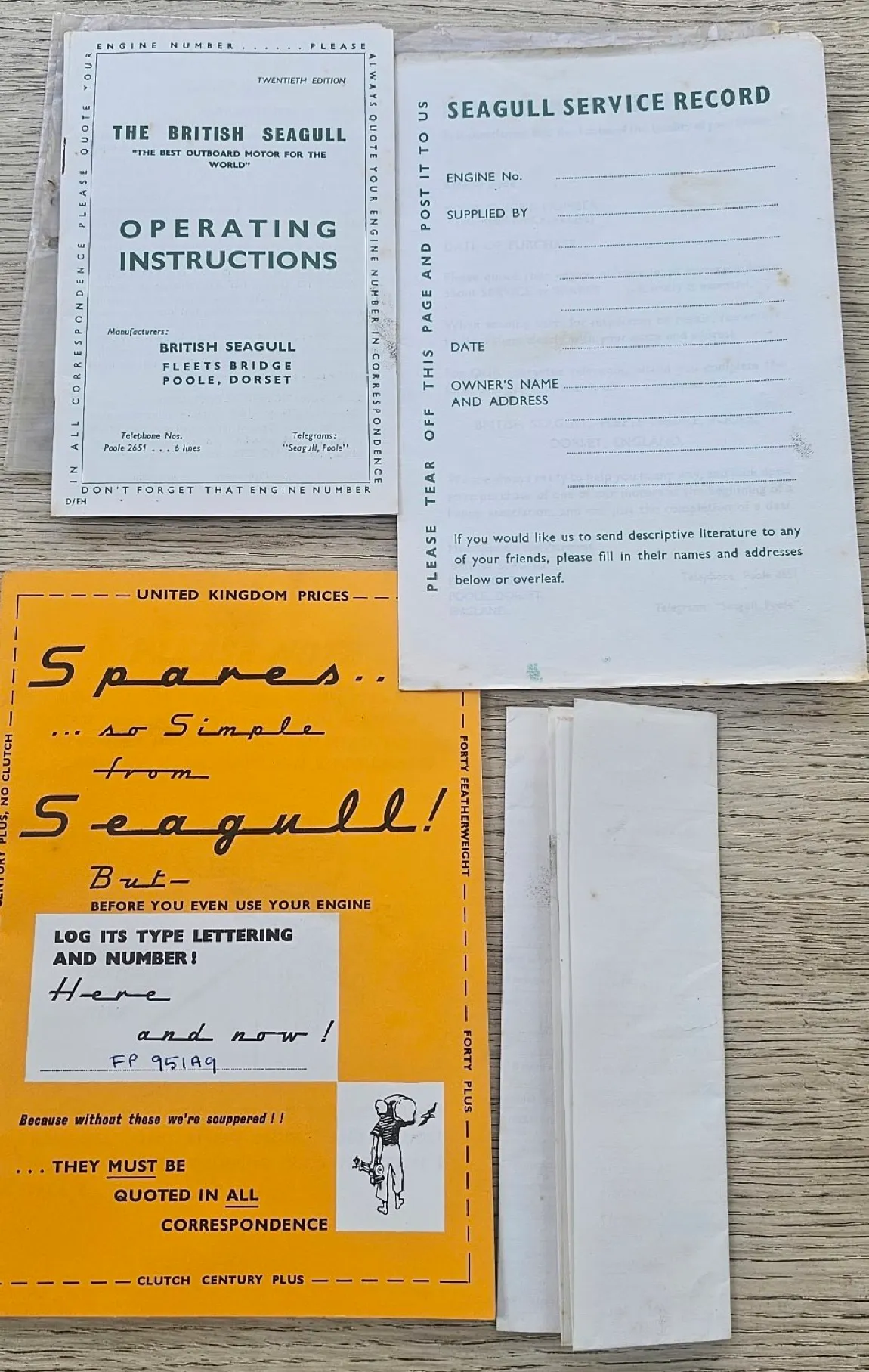 “Because without these we’re scuppered!!” — the spares leaflet, with the engine number filled in as instructed.
A letter from the builder, April 1962
The best of the paperwork is a single typed sheet on H. T. R. Poole letterhead: Harry Poole, the man who designed the class, answering an enquiry in his own time and signing it himself.
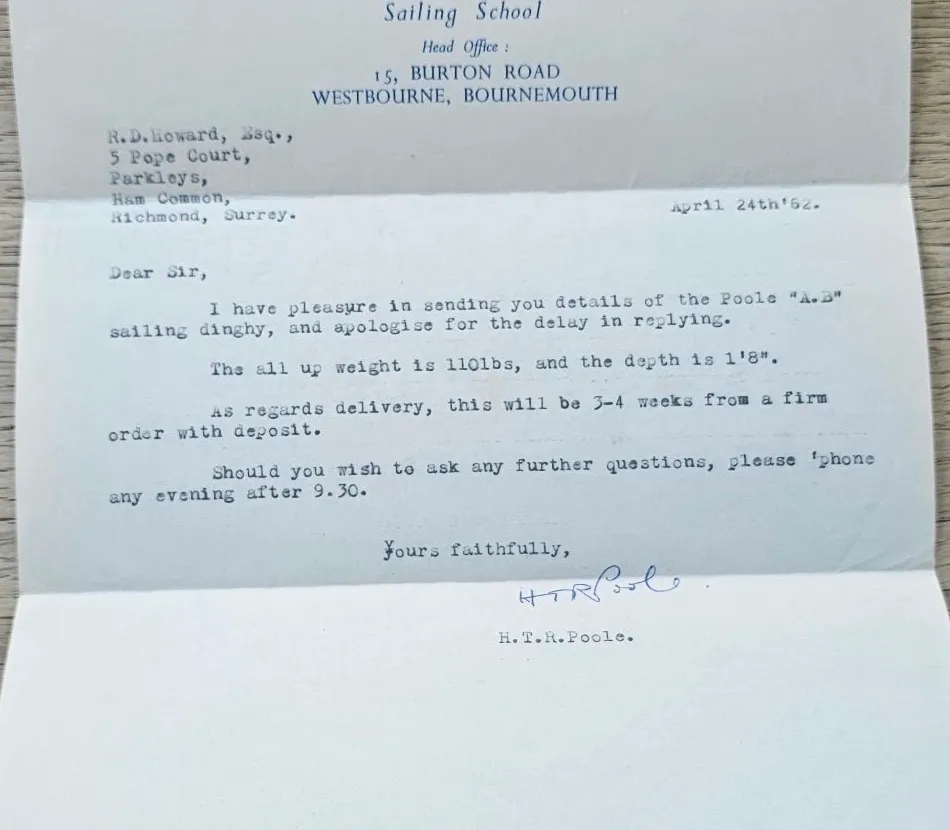 24 April 1962, signed H. T. R. Poole. The addressee’s details are on the original and are not repeated here.
I have pleasure in sending you details of the Poole “A.B” sailing dinghy, and apologise for the delay in replying.
The all up weight is 110lbs, and the depth is 1’8“.
As regards delivery, this will be 3-4 weeks from a firm order with deposit.
Should you wish to ask any further questions, please ’phone any evening after 9.30.
The head office was 15 Burton Road, Westbourne, Bournemouth; the works and sailing school were at Hamworthy Junction, Poole. The telephone number was Westbourne 65194, and you were welcome to use it after half past nine at night.
How she was sold
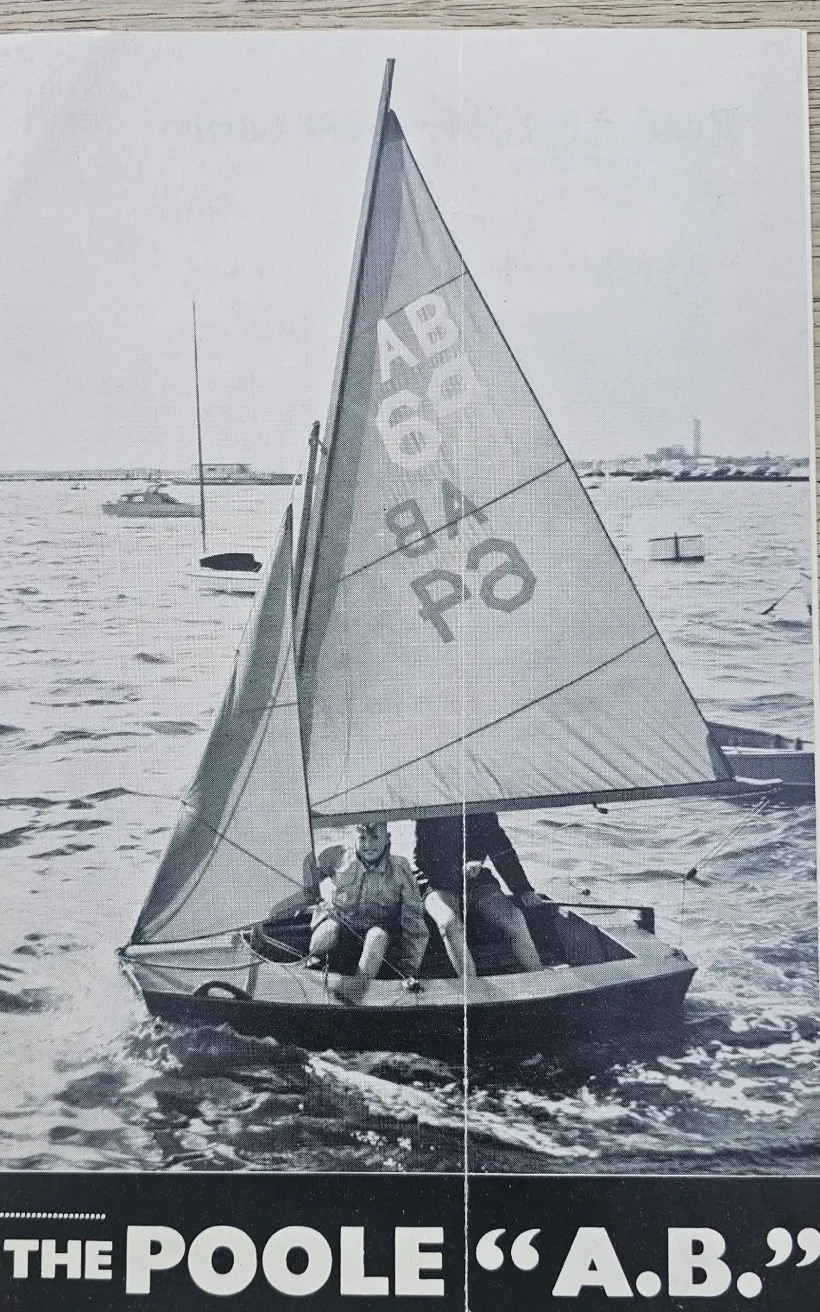 The brochure that came with her.
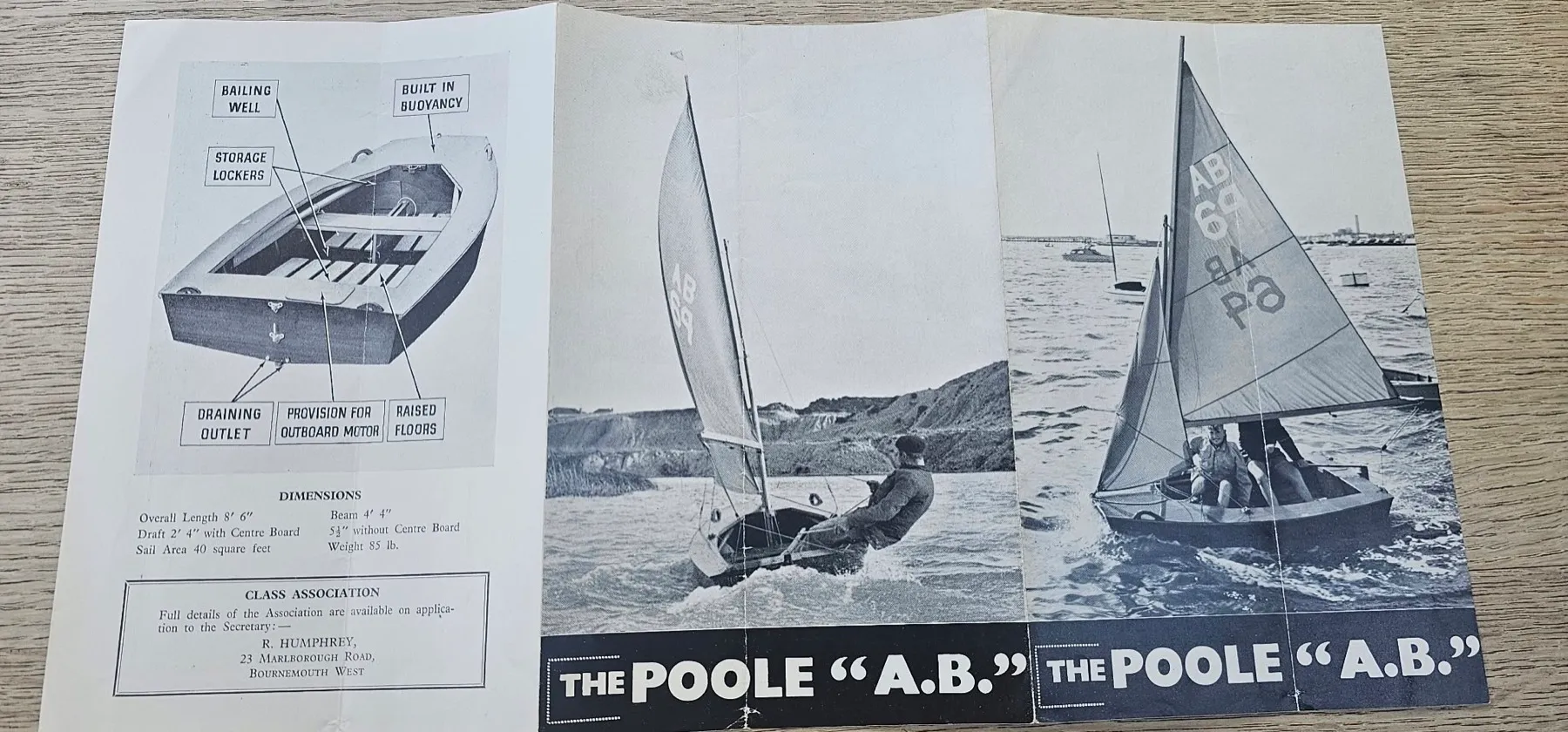 Opened out: the cutaway, the dimensions, and the class association’s address.
The dimensions, as printed:
- Overall length 8′ 6″, beam 4′ 4″
- Draft 2′ 4″ with centreboard, 5½″ without
- Sail area 40 square feet
- Weight 85 lb
The Class Association secretary of the day was R. Humphrey, 23 Marlborough Road, Bournemouth West.
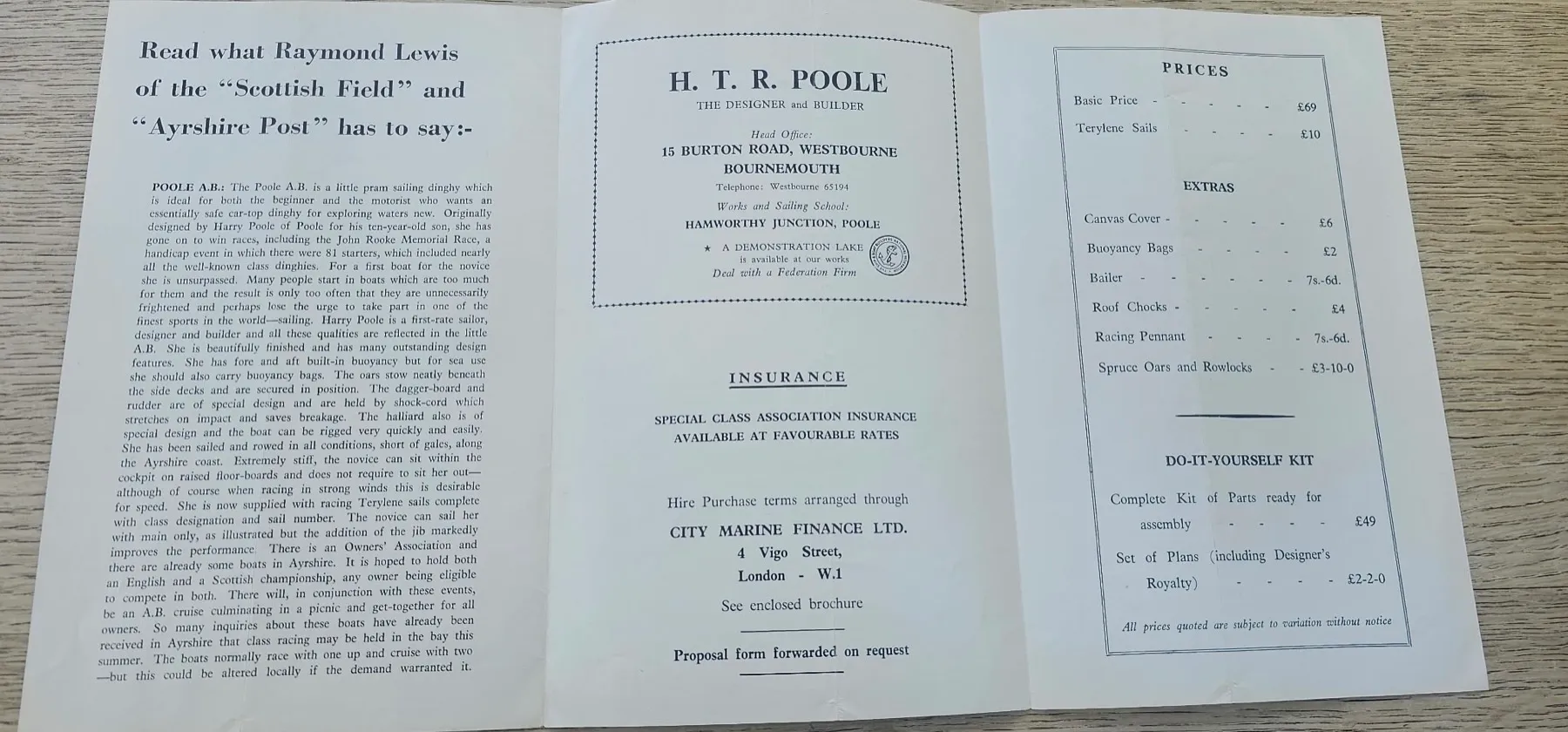 The inside: a press notice, the builder’s panel, and what she cost.
And what she cost:
- Basic price £69; Terylene sails £10
- Canvas cover £6; buoyancy bags £2; bailer 7s 6d
- Roof chocks £4; racing pennant 7s 6d; spruce oars and rowlocks £3 10s
- Do-it-yourself: complete kit of parts ready for assembly £49, or a set of plans including the designer’s royalty for £2 2s
The brochure also carries a press notice from Raymond Lewis of the Scottish Field and the Ayrshire Post, which records that Harry Poole originally designed her for his ten-year-old son, and that she had already won races — among them the John Rooke Memorial Race, a handicap event with 81 starters.
“A first-class little boat”
The last document in the folder is a reprint of a magazine boat test: the Poole “A.B.” car-top dinghy, tested by Ian Souter Clarence and reprinted from Watersport, November 1961. He sailed her in Poole Harbour in August 1961 in Force 3–4, with Harry Poole seeing him off the jetty, and admits at the top of the piece that he had never much liked very small dinghies.
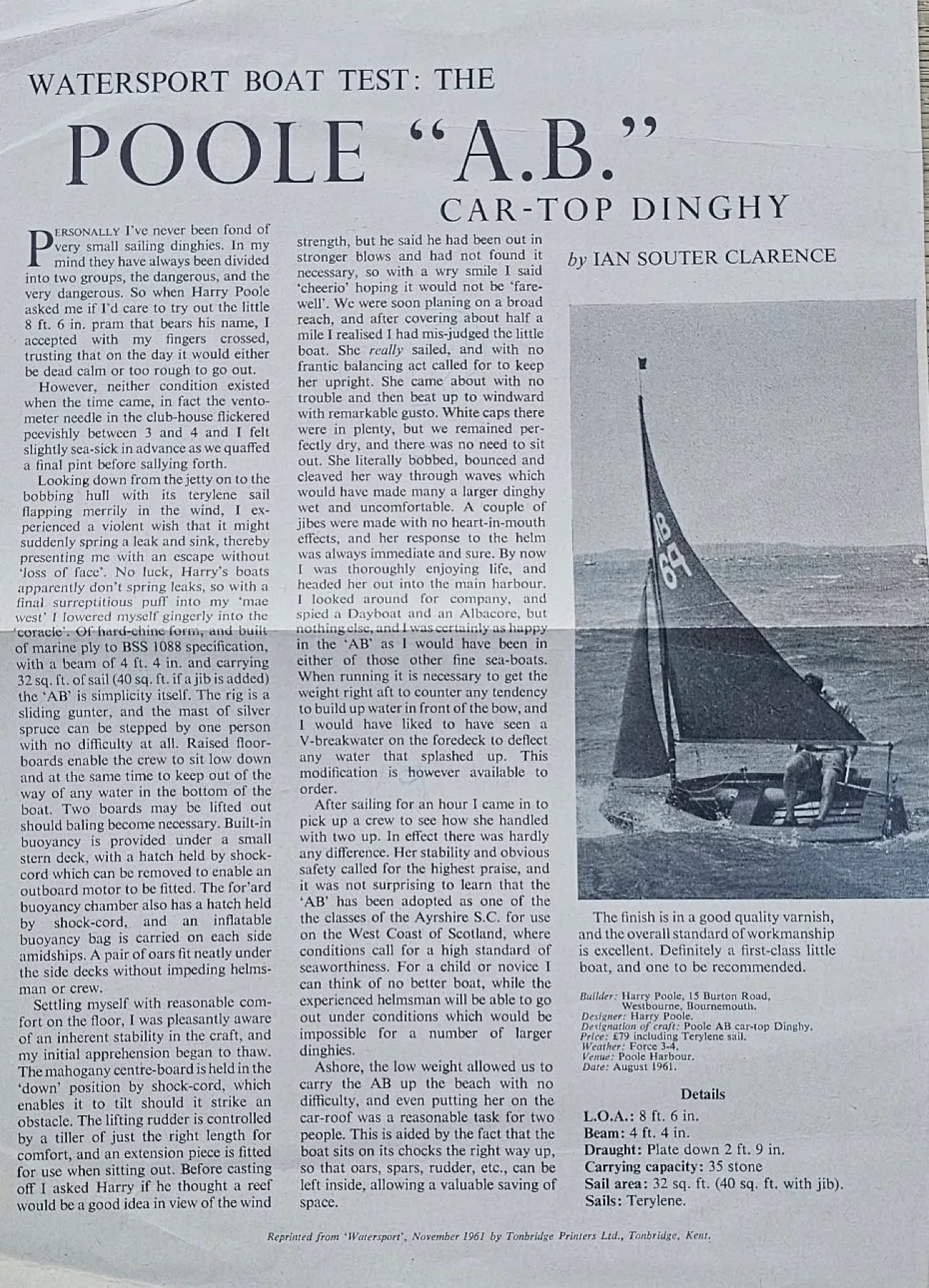 The boat test, reprinted from Watersport, November 1961.
He came back recommending her. The test also puts on record a few things the brochure does not: the hull is hard-chine, built of marine ply to BSS 1088 specification; the rig is a sliding gunter on a silver spruce mast one person can step; the centreboard is mahogany, held down by shock-cord so it can tilt if it hits something.
Its details panel reads: length overall 8 ft 6 in, beam 4 ft 4 in, draught 2 ft 9 in with the plate down, carrying capacity 35 stone, sail area 32 sq ft or 40 sq ft with the jib, Terylene sails, price £79 including the sail. That last figure is the brochure’s own arithmetic — £69 for the boat and £10 for the sails.
First, does she float
The first job was the simple one. Her new owners planned to launch her the weekend after she came out, and if she took to the water as well as she had taken to the camera, the reward would be a sail across the harbour to Brownsea — the passage these boats were built for, and the one the fleet still makes every July.
Update: she floats. At the end of August she went into the water for the first time in more than sixty years, and she was sound enough for a row around with the mast stepped.
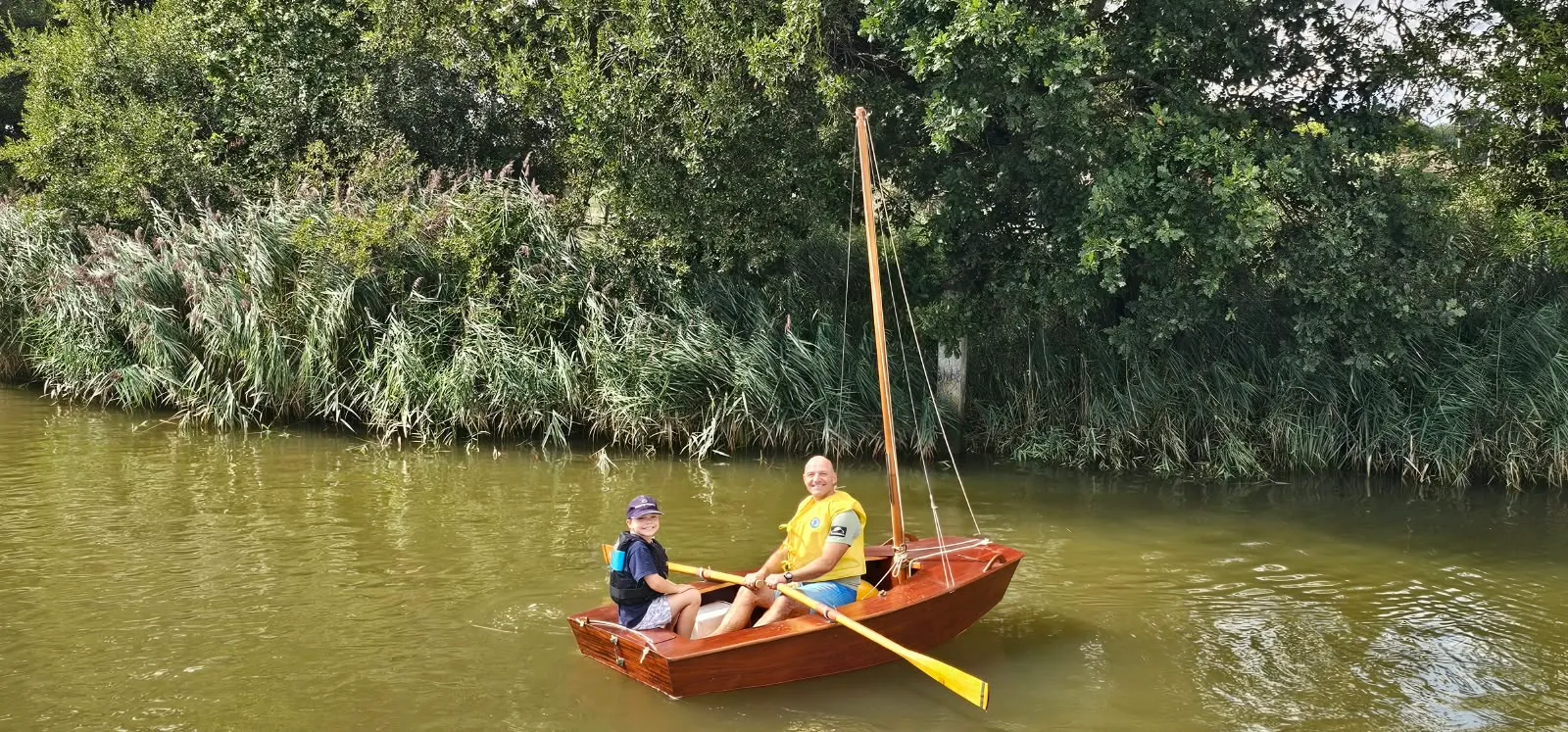 Back on the water, under oars.
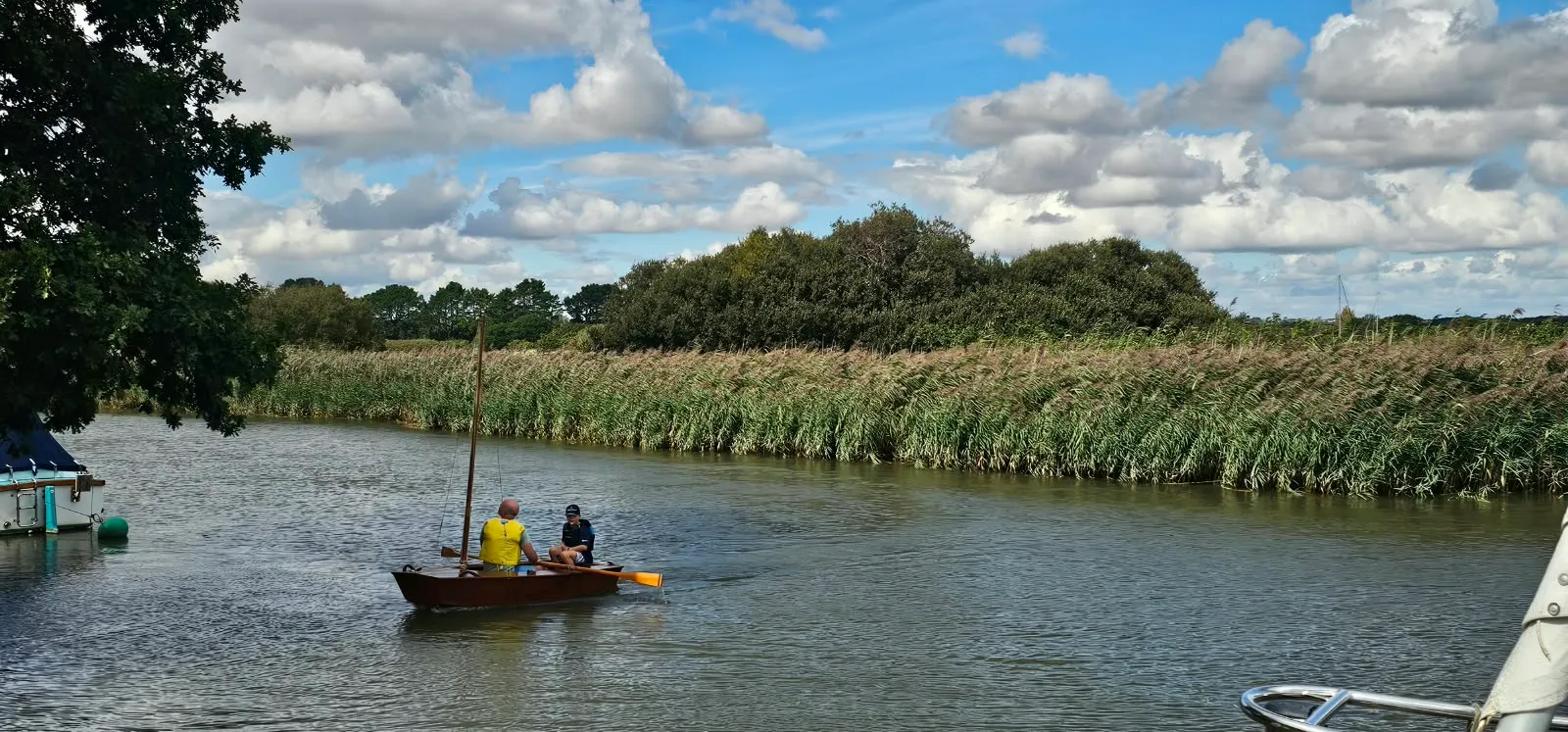 Heading off for a row around.
And then what
What we do with her after that is anyone’s guess: museum? Donate to the club? Try to race her?
It is a genuinely open question. A boat this original is a time capsule of Poole Harbour sailing, and whether she belongs in a collection, in the club’s care, or back on a start line with the rest of the fleet is worth an argument.
If you have a view, or you remember her from before 1965, tell us. She is not in the register yet, and a hull that arrived with her own paperwork is exactly what it exists to record.